
Unmoderated user research
Run studies. Keep every answer.
Build surveys, card sorts, tree tests and website tasks from blocks, share one link, and turn responses into findings that cite the exact answers behind them.
Free and open source. Participants answer anonymously — no account needed.
What you get
Precise answers, from study design to finding
Every block, response and decision is stored, versioned and exportable — and nothing is excluded behind your back.
Studies built from blocks
Welcome and consent, multiple choice, opinion scales, open text, yes/no, website tasks, closed card sorts and tree tests. Add skip logic and screeners, then preview with nothing recorded.
- Publishing freezes an immutable version
- Cap participants or set a close date
- Duplicate a study to run it again
- 1Welcome & consentIntro
- 2How often do you order?Multiple choice
- 3Rate checkout todayOpinion scale
- 4Find the delivery addressTree test
- 5Group the help topicsCard sort
Skip logic: if “Never” on block 2 → end with screen-out.
Tree testing, task by task
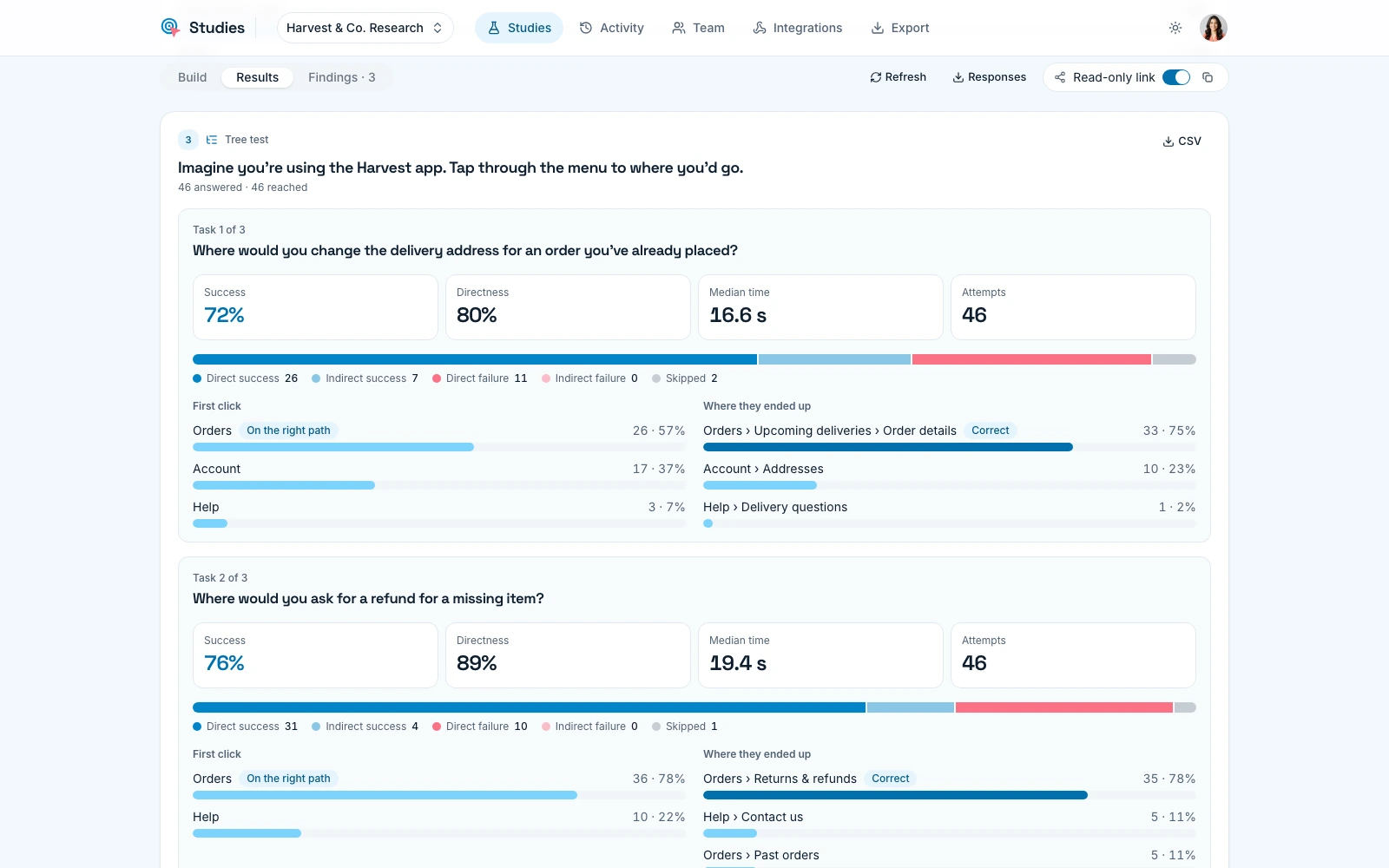
Participants navigate a text-only tree one task at a time. For each task you see success rate, directness, median time, the outcome split, first clicks and where people ended up.
- Find a return label86%
Success · 74% direct · median 18 s
- Change the delivery address72%
Success · 58% direct · median 24 s
- Contact support about a refund41%
Success · 29% direct · median 51 s
Quality flags you decide on
Speeders, straight-lining and empty or junk open text are flagged with the reason. You exclude a session with a written reason or keep it — both are audited, and nothing is excluded automatically.
Session #A3F2
Speeder — 38 s against a 2 min 10 s median
KeepExclude…Session #B71C
Straight-lining — same rating on 4 scales
KeepExclude…Session #C20E
Empty or junk open text
KeepExclude…
Excluding asks for a reason, and both choices go in the audit log.
Findings that cite their evidence
Record a finding with a severity and at least one piece of evidence: a specific session's answer or a whole block. The server checks every citation and keeps an excerpt.
- Shared results show findings above the charts
- No raw sessions on the share link
The address change is buried under Orders
Most people looked under Account → Addresses first, and a fifth gave up on the task.
Evidence
- Block 4 · Task 2 — 72% success, 58% direct
- Session #D09A · Open text: “I went to Addresses and it only had my saved ones.”
How it works
From question to finding in four steps
- 01
Build the study
Stack blocks, add skip logic and screeners, and preview it exactly as a participant will see it.
- 02
Publish and share
Publishing freezes a version. Share one participant link; cap responses or set a close date.
- 03
Collect answers
Participants consent and answer anonymously, and the server validates every response against the frozen version.
- 04
Analyse and cite
Read results per block, review quality flags, exclude with a reason, and record findings that cite answers.
Switching from Maze?
Bring your Maze results with you
Import a Maze results CSV. You see exactly how each column maps — block type, timing, metadata, dropped — before anything is written, then analyse it like any other study.
- Imported as a closed, read-only study you can analyse, exclude, cite and export — or duplicate to re-run in Studies
- Emails, names, IPs, device and location columns are dropped, and the preview says so
- Click paths, heatmaps and recordings aren't portable from Maze, so they aren't imported
Open source, open data
Your participants' answers stay yours
Studies is free and open source under the AGPL-3.0. Read the code, export every response, and wire results into your own tools.
Exports at every level
Study responses as JSON (with quality flags, decisions and findings), a CSV per block, and the complete workspace bundle.
Signed webhooks
HTTPS endpoints for response.completed and study.closed, signed with HMAC-SHA256, with a delivery log that shows failures honestly.
An audit log
Every researcher action is recorded — including each exclusion and the reason behind it.
Roles enforced on the server
Admins, researchers and viewers. Viewers read results; every write they attempt is refused.
Questions
What researchers ask first
Ask your next question properly
Create a workspace, build a study from blocks and share the link with your first participants.
Build your first study